
Scott ICE Transfer and Release Paths
An immigration detainer asks a local agency to notify ICE of an impending release and may ask for continued detention for up to 48 hours so ICE can assume custody. Scott's system may correctly say “released” because county custody ended even as immigration custody begins.
ICE custody may later end through release under the applicable process, transfer, removal, or another change. A missing locator result cannot identify which occurred. The Scott receiving-agency field, ODLS result, ERO response, and immigration case record must be read in sequence.
| Event | What it proves | What remains open |
|---|---|---|
| Scott release to ICE | County custody ended and ICE was the destination | Current immigration location or later release |
| ODLS current match | ICE reports searchable present detention | Outcome and future movement |
| ODLS recent-release match | ICE reports release within its recent window | Long-term status and other custody |
| No ODLS match | No matching public result | Recent intake, exact-match issue, minor, old release, or nonsearchable custody |
Confirm an ICE Custody Change
The Online Detainee Locator System offers two main search routes. One uses the exact A-number and country of birth. The other uses exact biographical details presented by the system. Exact matching matters.
- Obtain the A-number from a reliable record when possible and search with country of birth.
- If no number is known, use the biographical search and try verified name details.
- Read whether ICE reports current detention or a recent release.
- Contact the responsible ERO field office with the identity and locator information.
- Request Scott's release or transfer entry when county custody preceded the ICE event.
The Scott County release search explains the local record needed before this federal follow-up.
ICE Locator and ERO Contacts
There is no verified Scott County ICE facility to list. ICE detention occurs through a network of federal and contractor locations, so use the location shown by the current record and the responsible ERO field office.
Immigration custody routes
Online Detainee Locator: locator.ice.gov/odls
ERO field offices: ice.gov/contact/field-offices
ICE detention information: ice.gov/detention-management
For the local handoff, request the Scott County Detention Center record at 130 North Court Street, Georgetown, KY 40324, or call 502-863-7880. Ask for the release type, detainer, destination, and receiving agency shown for the booking.
Scott Has No Verified ICE Jail
Research did not verify an advertised ICE detention center or a current county ICE detention contract in Scott County. This is an absence finding, not a claim that immigration detainers never occur.
ICE can assume custody after a local jail release and house the person elsewhere. Facility geography is less important than identifying which sovereign held custody at each point. Scott's record ends the local segment. ICE records address the immigration segment.
Never merge an ICE result into a county “released inmates” list. The systems answer different questions and can update on different schedules.
ICE Locator's Recent Window
ICE states that ODLS covers people currently detained and people released from ICE custody within the last 60 days. A no-match after that period does not prove that ICE never held the person. Historical custody may require an agency record.
Some very recent bookings, minors, and people outside searchable custody may not appear reliably. Spelling, name order, country of birth, and A-number accuracy can also determine whether a match appears.
Record the search date and fields used. Then contact ERO rather than treating silence as a final answer.
Scott Detainer Records Matter
The most useful county fields are release time, release code, holds or detainers, and receiving agency. Together they show whether Scott sent the person into immigration custody rather than into the community.
- Detainer
- A request from another agency tied to notice or pickup; it is not itself a conviction.
- Receiving agency
- The custodian identified as accepting the person after Scott.
- Transfer
- A movement in which custody continues.
- Community release
- An end to physical custody without an immediate receiving custodian shown.
A court order can explain the local legal authority but may not describe the later immigration handoff. Use both records.
Official ICE Release Scope
The official ICE information page describes ODLS's current and recent-release scope.
The stated window explains why a historical absence is not reliable proof.
ERO Follow-Up for Scott Transfers
The official ERO field-office directory supplies the follow-up route when ODLS is incomplete.
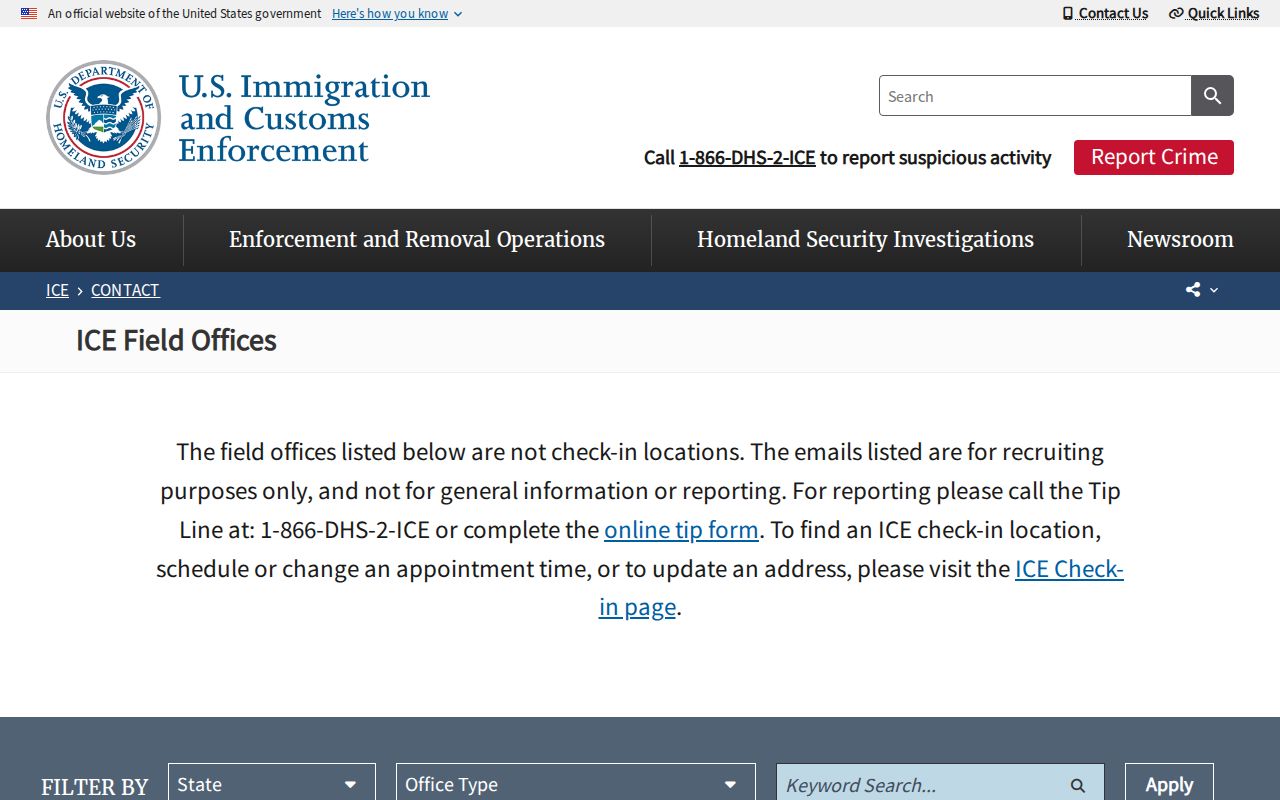
Use the office linked to the person's reported location or case, not an assumed Scott County facility.
Exact ICE Locator Matching
The A-number route is strongest when the number is known and verified. Enter it in the format the locator requests and pair it with country of birth. For a biographical search, use the exact name and birth details from a reliable document. Nicknames, reversed names, spelling differences, and compound surnames can prevent a match.
A result must be checked against all available identity facts. Do not rely on a similar name alone. Save the search time and the locator's wording, then use the listed location or ERO office for follow-up. If a recent Scott transfer has not appeared, allow for intake lag while still confirming the county handoff separately.
Minors and some other people may not appear in the public system. The absence of a result therefore has several explanations. State only that no matching public ODLS entry was found at that time.
Request Scott Transfer Proof
A narrow jail-record request should name the person, booking number, and approximate release date. Ask for the existing book-out entry, release code, detainer or hold fields, transport or transfer destination, and receiving agency. Those fields show what Scott County did without asking the custodian to decide the immigration case.
If the record names ICE, label the event as release or transfer from Scott custody to ICE. Do not shorten it to “released” when that wording would imply entry into the community. If another federal or local agency appears, follow that agency instead.
The Scott court record may show the criminal case disposition or bond order. It does not necessarily contain the immigration detainer or the actual pickup time. The jail record and federal follow-up fill those gaps.
ICE Records Beyond Sixty Days
ODLS's recent-release coverage is useful for a prompt check, but it is not a permanent public archive. After the stated window, request agency records or work through the responsible ERO office. Preserve any A-number because it is the best link between the old custody episode and later records.
A historical no-match cannot prove that detention never occurred, that removal occurred, or that the person entered the community. Those are separate outcomes. Use precise language about what the locator did and did not show.
When records conflict, compare dates and agencies before drawing a conclusion. Scott County can report its custody end correctly while ICE reports a later federal event. Both may be accurate because they describe different parts of the same movement.
ICE Custody Timeline Method
Start the timeline with the Scott booking and court event when a local case exists. Add the county release or transfer time, the named receiving agency, the first ICE record, later detention locations, and the reported ICE release event. This separates agency handoffs that may all use the word “release” in a narrow sense.
Dates should be attributed to their source. A Scott date is a county custody date. An ODLS date or ERO response concerns immigration custody. A court date concerns an order or hearing. None should be silently substituted for another.
If the person moved through a contractor facility, the federal custody authority still controls the ICE record even when the building is privately operated. Use the location for contact, but use ICE and ERO for the federal custody status.
When ODLS Shows Release
A recent-release result is useful affirmative evidence that ICE reports the person released from its custody within the locator window. Preserve the exact wording and search date. Then ask ERO for the releasable custody record when documentary confirmation is needed.
That result does not resolve the full immigration case and does not rule out another custodian. It should be stated as an ICE custody result. If a state, local, or federal criminal hold appears, follow that authority separately.
VINE and the Scott roster are not replacements for ODLS. They may cover the county booking or another participating custody entry, but immigration detention needs the sovereign-specific federal route.
Use exact identity details for each search.