
Federal Release Paths for Scott Cases
A person can leave BOP for the community, a residential reentry placement, another jurisdiction, or immigration custody. Federal supervised release may begin after imprisonment, so release from a prison is not the same as the end of all sentence obligations.
“Released” or “Not in BOP custody” speaks only to BOP's reported custody. The person could be held by the U.S. Marshals, Kentucky, a local jail, or ICE. BOP release statistics also treat transfers to other jurisdictions differently from ordinary community releases.
| Result | What it supports | What to check next |
|---|---|---|
| Released with date | BOP reports the federal prison episode ended | Federal docket and any later custodian |
| Not in BOP custody | BOP does not report current custody | USMS, state, local, or ICE path |
| Current institution | BOP reports present placement | Institution contact and sentence record |
| No match | No matched public BOP result | Identity, older records, court case, or pretrial custody |
Confirm a Federal Prison Release
The BOP Inmate Locator covers federal inmates from 1982 to the present and includes some older records. Search by BOP, DCDC, FBI, or INS number when known. A name search can be narrowed by age, race, and sex.
- Enter the strongest identifier available and open the matched federal record.
- Compare name, register number, age, race, sex, location, and release date.
- Save the result time because sentence calculations and custody can change.
- Find the prosecution and judgment in PACER or the relevant federal district docket.
- Check another sovereign only when the record indicates transfer or a separate custody basis.
For a local booking that preceded federal custody, the Scott County release records route can establish when the county handed the person off.
Federal Release Records and Contacts
No nationwide institution address belongs in this contact card because no BOP facility was found in Scott County. Use the institution shown on the matched locator record. For the case, PACER and the Eastern District of Kentucky are the durable official court channels.
Federal system routes
BOP Inmate Locator: bop.gov/inmateloc
PACER Case Locator: pcl.uscourts.gov
Eastern District of Kentucky: kyed.uscourts.gov
U.S. Marshals prisoner information: usmarshals.gov/what-we-do/prisoners
A request should identify the person by register number and ask for an existing release or custody record. Court records can show the sentence and supervised-release term, but a docket entry may not show the exact movement time.
Federal Custody Is Nationwide
The BOP is a nationwide prison system, not a Scott County jail. Federal defendants can be designated far from the county where they lived or were arrested. Facility geography therefore cannot replace a sovereign-specific search.
Before BOP designation, the U.S. Marshals Service manages federal detainee custody and transport. It may house a person in a local facility, but it does not provide a broad public real-time locator like a county roster. The federal docket, counsel, housing facility, and relevant Marshals district form the verification chain.
A defendant held pretrial by the Marshals may not yet have a BOP inmate-locator result. No match must not be presented as proof of release.
Scott Federal Docket Confirmation
PACER is the federal case source for the prosecution, judgment, sentence, later orders, and supervised-release proceedings. A BOP date should be compared with that record, especially when an appeal, sentence reduction, revocation, or First Step Act calculation may affect timing.
The federal court record and BOP serve different jobs. The judgment explains legal authority. BOP reports its correctional custody and release date. Neither alone proves that no state, local, or immigration custody followed.
The Eastern District of Kentucky is the relevant local federal court entry when the prosecution occurred there. Search by party name and verify the case number before relying on an event.
BOP Result Fields Explained
A federal locator result can show name, register number, age, race, sex, release date, and location. The register number is especially useful because names can match. The release date is tied to the federal record, not to Scott County's booking system.
- Register number
- The stable BOP identifier used to distinguish people.
- Release date
- The date BOP reports for the federal custody episode.
- Location
- The current institution or a release-related display.
- Supervised release
- A court-ordered federal supervision term that can follow prison.
First Step Act recalculations can make an older displayed date stale. Capture the current result and reconcile it to the court record.
Federal Locator Source View
The official BOP Inmate Locator is the correct nationwide public search, as shown in the successful manifest capture.
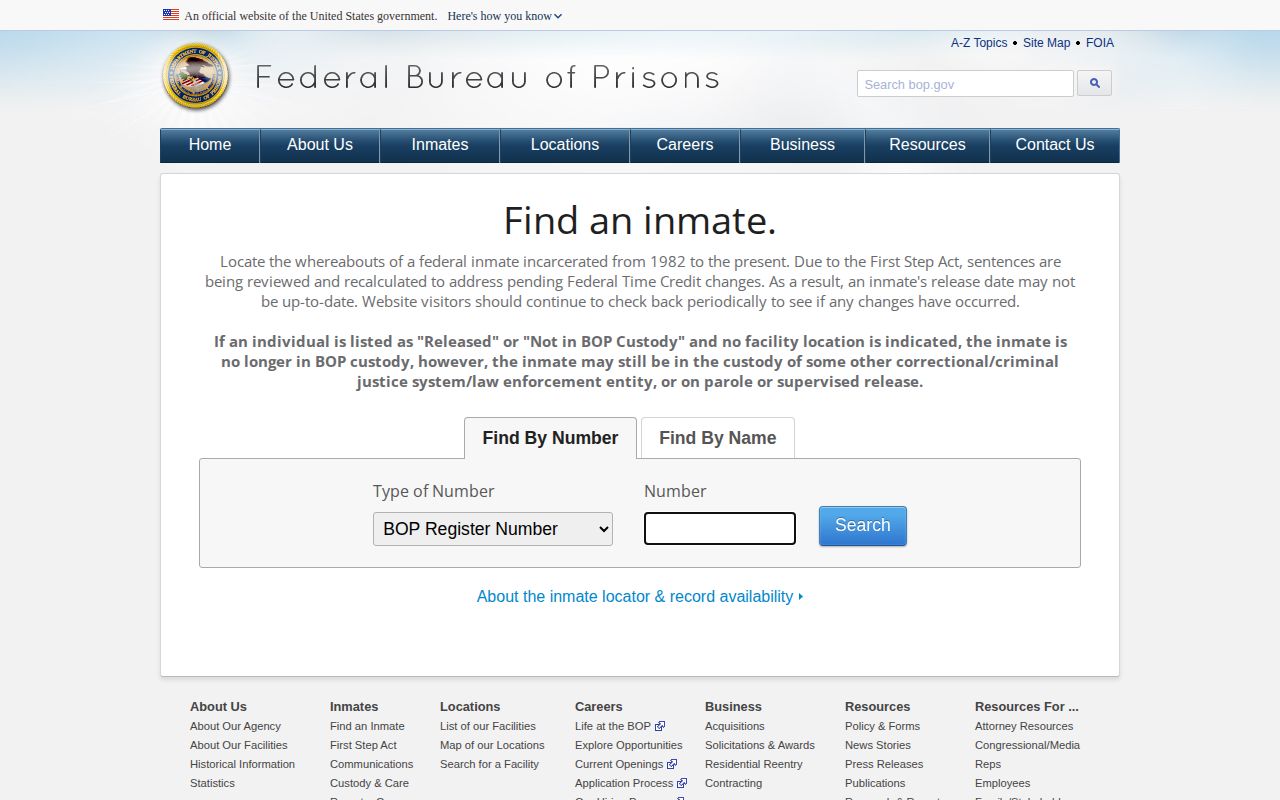
The form's federal identifiers and biographical filters help prevent a county-jail record from being confused with a federal record.
PACER Preserves the Case Trail
The PACER Case Locator provides the court counterpart to the custody result.

Used together, PACER and BOP distinguish the sentence from the agency's report of physical custody.
Federal Release Date Changes
A BOP date can change after sentence computation, earned-time application, disciplinary action, a court order, or another correction to the record. First Step Act calculations are one reason an older capture can become stale. Search the current locator, record the time, and compare the result with later docket events.
Do not substitute a parole concept from Kentucky for federal supervised release. Federal supervised release is imposed by the federal court and generally follows imprisonment under the judgment. A person shown as released by BOP can still have reporting and other court-ordered duties. The probation office and docket, not a county roster, address that part of the sentence.
If a revocation later returns the person to custody, the federal docket and locator may show a new sequence. Keep each imprisonment episode and date tied to its own court events. A single old “Released” screen cannot describe all later custody.
USMS Custody Before BOP
The Marshals hold federal defendants from court-ordered detention through acquittal or conviction and delivery to BOP. They may use local detention space. This can make a local facility appear in the physical path even though the federal government controls the detention.
No nationwide public USMS prisoner search was found. For a pretrial person, use the federal docket, defense counsel, known housing facility, and the relevant Marshals district. Ask a precise custody-location question with the case number and verified identity. Do not report a BOP no-match as a release.
After sentencing, designation and transport can create another gap before the public BOP location settles. The judgment confirms the sentence, while custody agencies confirm movement. If Scott County participated in the handoff, its receiving-agency field documents only that local segment.
Transfers After Federal Prison
A federal prison departure may lead directly to another jurisdiction. State or local warrants, immigration action, or another valid custody basis can prevent community release. The BOP result does not search those systems for the reader.
Follow an identified destination narrowly. Check ICE only when immigration custody is indicated. Check Kentucky or a local jail only when a state or county authority is shown. Broadly searching unrelated systems can produce false matches and blur separate people or events.
For documentary confirmation, request the BOP custody or release record, keep the federal judgment, and obtain the receiving agency's record when transfer occurred. Together they show when BOP custody ended, why the sentence existed, and whether another custodian immediately followed.
Federal Identity and Record Requests
The BOP register number is the best anchor for a federal record request. Pair it with the full name, date of birth, institution if known, and approximate release date. Ask for an existing custody or release record rather than asking staff to research a person's complete legal status.
PACER searches should also be narrowed by court and case number. Similar names can appear in different districts. The criminal case contains the judgment and later sentence orders, while a separate supervised-release proceeding may add revocation events. Read the docket chronology, not just the last entry.
If an older federal record predates the locator's main coverage period, use BOP's stated historical routes rather than concluding that no incarceration occurred. Some older records are included, but public coverage is not a complete substitute for agency archives.
Scott County Federal Boundaries
Scott County offices cannot certify a BOP release that occurred elsewhere. They can certify only records they created, such as a local arrest, booking, court event, or transfer. The federal agency owns the federal custody record.
This division also applies in reverse. A BOP result cannot establish Scott County's exact book-out time. When both systems touched the person, build the chain from each originating record and use the receiving-agency fields to connect them.